How to Abort a Baby Inside the Womb at Home
This mail service may incorporate affiliate links. If you purchase through these links, we may earn a small commission at no additional cost to yourself.
Your doctor can tell precisely what position your infant is in.
However, it's non always and so piece of cake for the momhoped-for to tell which position her baby is in at any given moment.
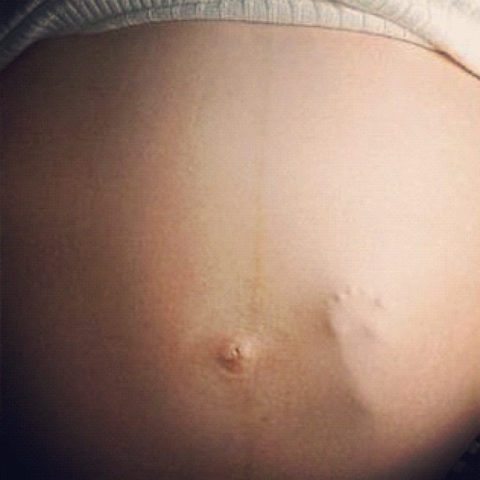
As you lot progress farther along in your pregnancy, it will become easier to determine your baby's position inside the womb.
Y'all volition get-go to notice some "signs".
What Position Is Your Baby In Right Now?
Here's how to decide the position of your unborn baby yourself:
#1 – If your belly and bellybutton pop out and/or you feel kicks under your ribs, chances are your babe is in the anterior position, with his or her back facing your front.
#2 – If your abdomen appears slightly flatter and/or y'all feel your baby's kicks at the very front of your breadbasket, your baby is probably in the posterior position, with his or her back side by side to your back.
#3 – If you feel a lump near the peak of your belly (usually on one side or the other) push button lightly on it. So:
- If you feel the whole infant motion, he or she is most likely head down, meaning you pushed on the baby's bottom.
- If the lump you feel moves by itself, without the residuum of the babe's body re-situating inside your belly, then that lump is probably the infant's caput, which moves independently of the rest of the baby's trunk.
#iv – If you experience your babe'south hiccups lower in your belly, then the baby is head downwardly.
#5 – If the infant's hiccups are above in your belly, or even above your belly button, then your baby is most likely head upwards.
#6 – If the baby is kicking higher up your navel, he or she is head down and in a skillful position for labor and birth.
#7 – If you lot're feeling extreme abdominal and rib pain, and you're in the afterwards stages of pregnancy, then your infant is probably head up with his or her caput close to or under your ribs. If you don't have this pain, your baby is probably caput down, not breech.
#viii – Using a fetal stethoscope

(or fifty-fifty a toilet newspaper roll), have your partner listen for your baby'due south heartbeat. Then:
- If the baby's heartbeat is low in your belly, the baby is caput downward.
- If the baby'south heartbeat is either level with or above your belly push, the baby is head up.

Unborn Babies Move A Lot
Keep in mind, near babies are fairly active inside the womb and they turn a lot — even during labor.
So, chances are, whatever position your baby is in at present will not be the same position he or she will exist in a few hours from now.
Keep in listen, it's not until the middle of your pregnancy that you will brainstorm to feel this quickening (or your baby's first fetal movements).
Hither's what to expect those first few times you feel your baby moving inside the womb, and why it's important to count your infant's movements.
This is a must-see video of baby moving around within mommy's belly:
Typical Baby Positions Inside The Womb
To give y'all an idea, the most common positions that babies assume in the womb are:
- Optimal position — the baby's head is downwardly and the babe is facing the mother'southward back. This is the optimal and near common birthing position
- Occiput or cephalic — the baby'due south caput is down, and the babe is facing the mother's abdomen. This position results in back pain and a prolonged labor.
- Transverse — the babe is lying crosswise in the uterus, side-to-side over the mother's pelvis, in a horizontal position rather than vertical. Usually, the baby's head will exist tilted more toward 1 side of your pelvis or the other and the baby'south shoulder will be pointing toward the birth culvert.
- Complete breech — the infant'south head is upwardly, so his or her lesser will enter the birth canal first. Both the hips and the knees are flexed (or bent).
- Frank breech — the infant's head is up, so his or her bottom will enter the birth culvert first. The hips are flexed (aptitude), while the the knees extended straight out.
- Footling breech — the baby's head is up, and 1 or both of the baby's anxiety are pointed down toward the nascency canal.
Must read:Infant Positions In The Womb: What Each One Means
So at present you know a little virtually the baby positions prior to delivery. Adjacent, we'll talk near what you need to know if your baby is in the breech position.
What If Baby Is In The Breech Position?
The good news is there is no reason to go stressed if your baby is breech (or not head down) fifty-fifty during the belatedly stages of pregnancy — because near breech babies plough but before the pushing stage during labor.
As long every bit you've been getting regular check-ups and following your doctor's advice throughout the pregnancy, and then you accept goose egg to worry about.
When the fourth dimension comes to deliver your baby, your doctor will know what is best for yous and your babe and if a cesarean section is necessary or not.
More About Fetal Baby Positions
In addition to the links I've included above, here are some other resource to help you learn more than about the different baby positions inside the womb:
- Positioning Your Baby For Labor
- The Ultimate Guide To Babe Positions In The Womb
- How To Do Belly Mapping & Know Your Infant'due south Position
- Optimum Fetal Position
- Birth Presentations: How Does Your Babe Lie?
- Slideshow: Baby Positions Before Nascence

I like to help people discover unique ways to do things in order to salve time & money — so I write about "outside the box" ideas that almost wouldn't think of. As a lifelong dog owner, I often share my best tips for living with and training dogs. I worked in College Ed over 10 years before switching gears to pursue activities that I'k truly passionate about. I've worked at a vet, in a photo lab, and at a zoo — to name a few. I savour the outdoors via bicycle, motorcycle, Jeep, or RV. You can always notice me at the corner of Good News & Fun Times as publisher of The Fun Times Guide (32 fun & helpful websites).

pelletierhanotaink74.blogspot.com
Source: https://pregnancy.thefuntimesguide.com/baby_position_in_womb/
0 Response to "How to Abort a Baby Inside the Womb at Home"
Post a Comment